

Thermal runaway refers to abnormal thermal management failure within the Battery Management System (BMS). During charging and discharging, lithium-ion batteries continuously generate heat from diverse internal electrochemical reactions. Without an effective heat dissipation system, accumulated internal heat will gradually trigger power attenuation, and in severe cases, lead to combustion, explosion and other dangerous accidents — this whole process is defined as thermal runaway.
Causes of Thermal Runaway
Heat generation in batteries is affected by internal factors, including charge-discharge rate, internal resistance, depth of discharge, state of charge (SOC), and capacity, as well as external factors such as ambient temperature and heat dissipation mode.
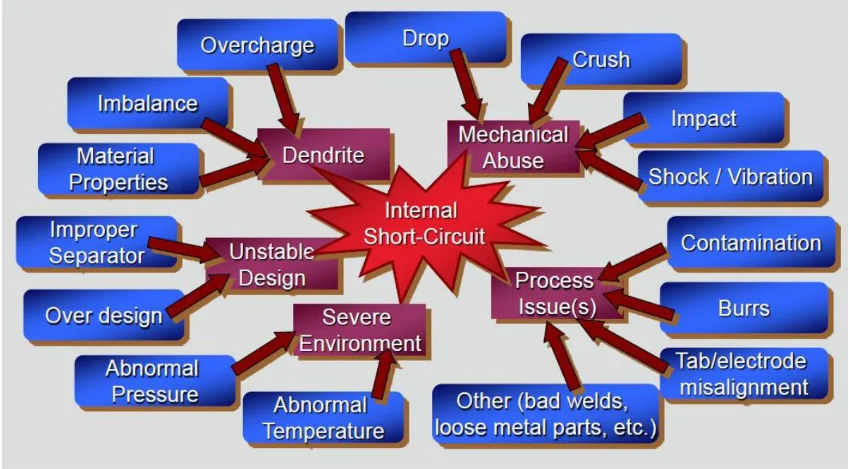
Thermal runaway of lithium-ion batteries is primarily triggered by short circuits, which are classified into two categories: static internal short circuits and dynamic internal short circuits.
Static Internal Short Circuits
Static internal short circuits stem from defective raw materials and flawed manufacturing techniques of batteries, lithium dendrite formation and cell aging during service, together with external environmental influences like temperature fluctuation and mechanical pressure.
Dynamic Internal Short Circuits
Dynamic internal short circuits occur during battery operation. Physical impacts, such as drops and collisions, can deform electrode plates, which eventually cause short circuits, ignition and even explosions.
Heat Sources of Lithium-ion Battery Thermal Runaway
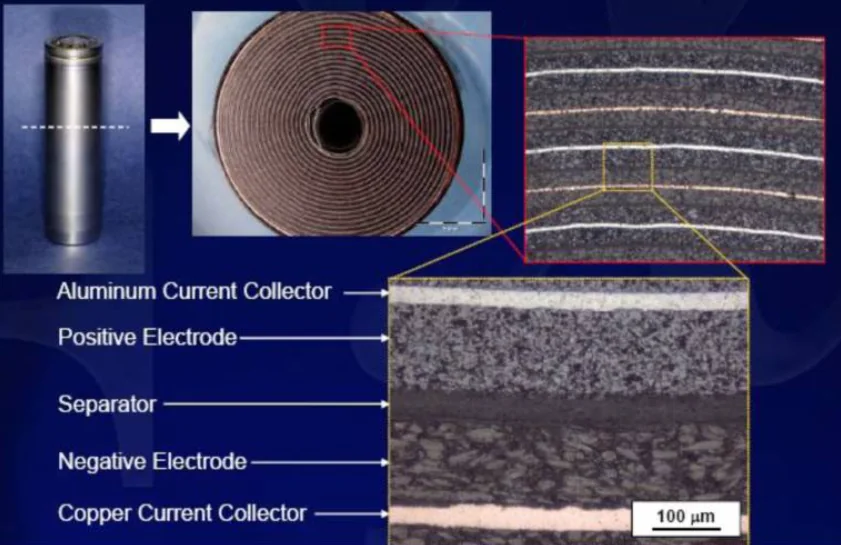
Thermal runaway arises from excessive accumulated internal heat that cannot be dissipated in time, eventually leading to fire and explosion. Major heat sources inside lithium-ion batteries are listed as follows:
I. Heat Generation from Reactions on Carbon Anode
1. Decomposition of Solid Electrolyte Interphase (SEI)
The SEI film consists of two layers: the inner layer is lithium carbonate (Li2CO3), and the outer layer is alkyl lithium carbonate represented by lithium ethylene dicarbonate CH2OCOLi. The outer layer decomposes at 80–120 °C, releasing heat and gas. The reaction temperature and heat output are determined by lithium salt type, solvent composition, anode active materials and battery cycle times. (CH2OCOLi)2−>Li2CO3+CH2=CH2+1/2O2+CO2 Li+(CH2OCOLi)2−>2Li2CO3+CH2=CH2
2. Reaction between Lithiated Carbon and Electrolyte Solvents (High heat output; a major trigger of thermal runaway)
As temperature rises, the SEI film fails to protect the anode. Lithium metal or lithiated carbon (LixC6) will react with carbonate solvents to produce gas and large amounts of heat: 2Li+C3H4O3(EC)−>Li2CO3+C2H4 2Li+C5H10O3(DEC)−>Li2CO3+C4H10 Li+C3H6O3(DMC)−>Li2CO3+C2H6
3. Reaction between Lithiated Carbon and PVDF Binder (Negligible at present)
Polyvinylidene fluoride (PVDF) is rarely used as an anode binder today, so this reaction is not considered here. When temperature exceeds 260 °C, PVDF reacts with lithiated carbon to generate gas and heat: CH2−CF2−+Li−>LiF+−CH=CF−+1/2H2
II. Decomposition Reactions of Cathode Materials
Layered, spinel and olivine cathode materials remain stable under 650 °C. Nevertheless, in a charged state, these materials can decompose and release oxygen as temperature increases. Li0.5CoO2−>1/2LiCoO2+1/6Co3O4+1/6O2 Li1−xNiO2−>2−x2−xLi1−x2−xNi12−xO+x2O2
Released oxygen further oxidizes electrolyte solvents and generates abundant heat and gas: 2.5O2+C3H4O3(EC)−>3CO2+2H2O 4O2+C4H6O3(PC)−>4CO2+3H2O 3O2+C3H6O3(DMC)−>3CO2+3H2O The exothermic reaction between cathode materials and electrolyte serves as the leading cause of battery explosion in most thermal runaway accidents.
III. Electrolyte Decomposition at Elevated Temperatures
Different carbonate solvents feature different decomposition characteristics and heat release. Common solvents include DMC, DEC and PC, while lithium hexafluorophosphate (LiPF6), the mainstream lithium salt solute, tends to trigger violent exothermic reactions with solvents. Its complex reaction with DEC is shown below: LiPF6<=>LiF+PF5 H2O+PF5−>PO3F+2HF C2H5OCOOC2H5+PF5−>C2H5OCOOPF4HF+C2H4 C2H5OCOOC2H5+PF5−>C2H5OCOOPF4+C2H5F C2H5OCOOPF4−>HF+C2H4+CO2+POF3 C2H5OCOOPF4−>C2H5F+CO2+POF3 C2H5OCOOPF4+HF−>PF4OH+CO2+C2H5F
IV. Other Heat Sources
Joule heat from internal resistance: The heat generated by current passing through internal resistance follows the formula I2RT. Internal resistance heat becomes the dominant heat source during battery short circuits.
Lithium metal deposition: Under certain conditions, lithium ions deposit on the anode surface in the form of metallic lithium, which will react with internal battery components and produce heat.